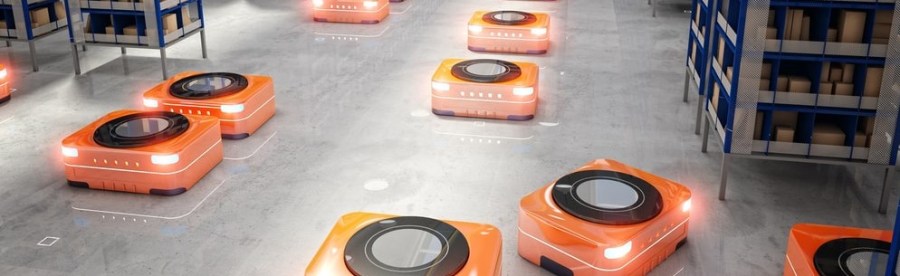
Autonomous mobile robots (AMRs) are robotic vehicles that can operate without needing human control or supervision. Using sensors, AMRs are sophisticated enough to identify obstacles and navigate around their environment – delivering inventory or tools to where they are needed. As they don’t take up much space, they are often used in environments such as manufacturing plants, warehouses and e-commerce fulfilment centres.
In this article, I look at some of the legal issues that we need to consider due to the rise of AMRs.
Autonomous Mobile Robots – health and safety issues
As always, work health and safety (WHS) issues are a priority. WHS is covered by both Commonwealth and State or Territory laws. In general, a person conducting a business or undertaking (or “PCBU”) is required to:
- As far as is reasonably practicable, ensure the health and safety of workers and other people in the workplace.
- Identify hazards at the workplace and associated risks.
- Implement control measures to eliminate or minimise the risks, so far as is reasonably practicable.
Health and safety regulations
More specifically, WHS regulations can apply to the use of industrial robots. In New South Wales (and other states and territories that have adopted the model WHS laws), there is specific regulation of the use of industrial robots. For example, under section 222 of the Work Health and Safety Regulation 2017 (NSW), a person who manages or controls an industrial robot (or other remotely or automatically energised plant) at a workplace:
- Must not direct or allow a worker to work in the immediate vicinity of the plant if it could start without warning and cause a hazard – unless suitable control measures are in place to control the risks.
- If remote or automatic energising of the plant could risk health and safety, access must be controlled by isolating the area by:
- Isolating the area.
- Providing interlocked guards, presence-sensing devices or permit to work systems.
Under these Regulations, an industrial robot is specifically defined:
Industrial robot means plant that is a multifunctional manipulator and its controllers, capable of handling materials, parts or tools, or specialised devices, through variable programmed motions for the performance of a variety of tasks.
This definition has not kept up with the latest developments in AMRs. The most up-to-date international standards provide a separate definition of a mobile robot and acknowledge that a mobile robot can be a “mobile platform with or without manipulators”. A manipulator has a specific meaning in robotics, being a mechanism usually consisting of a series of jointed or sliding segments that can grasp or move objects. Many AMRs only lift and move a pallet, rack or container, rather than being able to manipulate it in more than one axis.
Other regulations more appropriate?
Instead, the regulations specific to powered mobile plant (sections 214 and 215) or industrial lift trucks (section 218) might currently be the closest equivalents to how an AMR operates. Even these definitions are problematic. AMRs don’t have a “load-holding attachment” like a lift truck. And, AMRs are autonomous, so are not “ordinarily under the direct control of an operator”.
Industrial lift truck means powered mobile plant, designed to move goods, materials or equipment that is equipped with an elevating load carriage and is in the normal course of use equipped with a load-holding attachment, but does not include a mobile crane or earthmoving machinery.
(Emphasis added)
Powered mobile plant means plant that is provided with some form of self-propulsion that is ordinarily under the direct control of an operator.
(Emphasis added)
AMRs are also different to fixed systems (for example, a palletising robot), which can be physically separated from the operator. AMRs are an example of a robot where there is often a much closer interaction between robot and humans, often involving the same space being shared and sometimes at the same time. This determines the types of safety measure that will be needed to stay compliant.
Remember also that hazards can affect people who are not directly interacting with the robot (for example, excessive noise could affect anybody in the vicinity).
International and Australian standards on robotics
Safety standards are also an important source of information. The first international standard relevant to the use of industrial robots was ISO 10218 (Robots and robotic devices – Safety requirements for industrial robots – Part 1: Robots). The most recent version, ISO 10218-1:2011, was updated so that it would be consistent with ISO/TS 15066, which is the Technical Specification for Collaborative Robots.
In the Australian context, there is also an Australian Standard for industrial robots – AS 4024.3301:2017 (Safety of machinery, Part 3301: Robots and robotic devices – Safety requirements for industrial robots – Robots).
In January 2020, an international standard was also published for driverless industrial trucks (ISO 3691-4:2020 Industrial trucks – Safety requirements and verification – Part 4: Driverless industrial trucks and their systems). The principles underpinning this standard are also likely to be relevant to the operation of AMR systems.
Liability issues
The move towards more use of the AMRs also has implications for who is liable when things go wrong. Liability principles are well established for traditional industrial machinery – such as where a forklift is involved in an accident. If something goes wrong, there might be damage or loss – for example, a worker is injured, racking or stock is damaged, or costs are incurred because operations are stopped.
In these cases, the person liable could be, for example:
- The manufacturer – because of a manufacturing defect.
- The company operating the equipment, or the individual user – because of incorrect use.
The position can start to become more complicated when more advanced equipment is introduced. Hardware, software and communications systems all have to interact with each other, and it might be less clear where the fault lies. Also, as systems become more advanced and start to rely more on artificial intelligence based operating systems, it may also become more difficult to understand why the equipment behaved the way it did in a particular situation – and therefore whose fault it is.
This complexity makes it important to have robust contractual arrangements in place with well-planned liability obligations that reflect actual risk assessments. This will make it clear who is liable for the different types of loss that might arise. These should also be considered alongside the organisation’s insurance cover.
Data security and privacy
Increasingly AMRs navigate around the warehouse environment using cameras and motion sensors. And although not widely used in current AMR technology, it could be that systems will make more use of voice control in future.
Cameras, microphones and other sensors collect data – which could include images of workers or site visitors or record their conversations. This could start to raise a few compliance issues to consider.
Privacy issues
Where the sensors collect personal information (that is information about an identified individual, or an individual who is reasonably identifiable), the Privacy Act applies. This includes compliance with the Australian Privacy Principles.
Do CCTV regulations apply?
Many, but not all, States and Territories have laws that regulate the use of CCTV, or other optical or recording devices. For example, in Victoria, there is legislation (the Surveillance Devices Act 1999 (Vic)) that covers the use of optical surveillance devices or listening devices.
Listening device means any device capable of being used to overhear, record, monitor or listen to a conversation or words spoken to or by any person in conversation […]
Optical surveillance device means any device capable of being used to record visually or observe an activity […]
The legislation makes it an offence to use devices to record private conversations or private activity. There are exclusions in that legislation that cover unintentional hearing of a private conversation or observation of private activity, or where people have given consent. However, devices cannot be used in sensitive or private areas, like washrooms. The approach is to take:
- What are the capabilities of the technology?
- What are the local regulations that apply?
- Are any operational adjustments required to ensure compliance?
For example, it might be that a procedure is required so that voice-control headsets to communicate with AMRs must not be worn in certain parts of the warehouse.
Workplace surveillance
New South Wales and the ACT also have specific legislation covering workplace surveillance. These rules require that employees be given notice.
Business continuity
Placing more operational reliance on AMRs means that the organisation needs to have confidence in the contingency planning. This might involve considering issues such as access to spare parts and the speed at which repairs can be undertaken. These are all issues that can be dealt with by having the right kinds of obligations the contract with the system provider.
COVID-19 has also shown that it’s important that these business continuity plans need to be tested in advance. Again, this is something that can be dealt with in a contract. There might be obligations on the system provider to share its business continuity plans or participate in wargaming different scenarios.
Workforce issues
As with any automation project, you will also have to consider the workforce implications. If the intention is that the system will allow for reduced headcount, involve HR professionals in planning for the redundancy process. What consultation and communication will be required? Are there specific issues, for example in an enterprise agreement, that might need to be covered off before AMRs can be introduced?
Think about what training and new skills will be required. Will the organisation have to hire people with new experience of working in an automated environment?
Final word
As the sophistication of AMRs goes up, and their price comes down, we are bound to see much wider adoption of the use of AMRs in supply chain and logistics operations. Successful implementation will require proper planning – and that includes being across the legal issues, such as those described here.
Please note: The articles published on this blog are for general information purposes only. They are not legal advice! You should always obtain your own legal advice about your specific circumstances.
 Michael Milnes